Antigua & Barbuda 7-Night Catamaran Itinerary: English Harbour to Pink Sand
A week-long Antigua catamaran itinerary linking Nelson’s Dockyard, the island’s best bays and a two-night Barbuda detour to the pink-sand beach.
Read more
If you are weighing a Caribbean charter for the 2027 season, the question is rarely “should I take a catamaran” — in the trade winds and shallow turquoise banks, the answer is almost always yes. The harder question is which one, because the best catamaran for Caribbean charter is never a single model — it depends on your group size, your budget, and how much you care about sailing performance versus living space.
This is a charter-fleet reality check, not a boat-show brochure. The eight models below — the Lagoon 42, 46 and 51, the Bali 4.4 and 4.6, the Leopard 45 and 50, and the Fountaine Pajot range — make up the bulk of what you can actually book out of Tortola, Marigot or Le Marin. Here is how the best catamaran for Caribbean charter changes depending on who is sailing with you.
A boat that wins a delivery passage across the Atlantic is not automatically the boat you want for a week of short hops between mooring fields. In the eastern Caribbean you sail beam-reach and close-reach legs of 8 to 25 nautical miles in 15–22 knots of trade wind, then sit at anchor for sixteen hours a day. That balance — short, breezy sailing legs and long hours at rest in heat — shapes what matters.
Three things move the needle here. First, air conditioning that can run through a humid night without flattening the batteries. Second, a deck and helm layout that lets two people reef quickly when an afternoon squall rolls through. Third, simple availability: the most suitable model is worthless if every example is booked from December to April.
Newer “loft-style” cats like the Bali range give you enormous saloons and flat foredecks, which families love. The cost is sailing feel — they are heavier and less lively upwind than a Leopard or a well-trimmed Lagoon. Crews who genuinely want to sail often prefer a slightly older, lighter design. Crews who want a floating villa lean the other way. Neither is wrong; just be honest about which one you are.
Lagoon is the name you will see most often on a Caribbean dock, and for good reason — there are simply more of them, so availability is the best in the category. The Lagoon 42 is the sweet spot for a couple or a family of four: three or four cabins, manageable for two competent sailors, and charter rates that typically land around €5,500–8,500 per week in low season, climbing well past that over Christmas and New Year.
The Lagoon 46 adds a flybridge helm, more tankage and a noticeably bigger saloon — the right step up for two couples or a family of six who want elbow room. The Lagoon 51 is a genuine six-cabin platform, the kind of boat two families split, and it is where you start seeing larger water and fuel tanks plus the option of a more serious generator and watermaker for true off-grid weeks. If you want the long-form verdict, our detailed Lagoon 51 review for Caribbean charter goes through the layout, performance and running costs cabin by cabin.
The flybridge helm that looks great in the Med can be a mild liability in a Caribbean squall, because the person at the wheel is one deck removed from the crew handling lines below. It is not dangerous, just a reason to brief your crew clearly before the first reef-down. Lagoons also sail flatter and less crisply than a Leopard, which matters more to sailors than to sunbathers.
The Bali concept replaces the usual cockpit-and-trampoline arrangement with a solid foredeck and a tilting garage door between cockpit and saloon, so indoor and outdoor merge into one giant living level. For a group that plans to spend more time anchored at Cane Garden Bay than beating to windward, this is the most comfortable layout afloat.
The Bali 4.4 suits a family or two couples; the Bali 4.6 scales that up with more cabins and a forward cockpit you will actually use for sundowners. The honest downside: weight. These boats are not eager upwind, and in light air you will motor more than you would on a Leopard. In the trades that rarely bites, but plan your day to sail off the wind where you can.
Built by Robertson and Caine in South Africa, Leopards have a loyal following among people who came to the Caribbean to sail, not just to swim. The Leopard 45 is responsive, points respectably for a charter cat, and has a forward cockpit accessed through the saloon — a feature that pays off on a breezy passage to Anegada when you want a sheltered spot up front. The Leopard 50 brings the same DNA to a larger six-cabin boat.
Leopards tend to handle a squall well: single-level helm, lines led sensibly, and a hull that does not wallow when the gust hits. The trade-off is that the saloons, while perfectly comfortable, feel a touch less cavernous than a Bali of similar length. For most experienced charterers that is a fair swap.
Afternoon squalls in the BVI and the Grenadines often arrive as a dark line with a 10–15 knot jump in wind for fifteen minutes. The boats that cope best share traits: a helm with clear sightlines, a first reef you can put in single-handed, and a rudder that keeps bite. The Leopard 45 and the Lagoon 42 both score well on this in practice; the heavier loft-deck cats need a little more anticipation.
Fountaine Pajot models — the Astréa 42, the Elba 45, the Saona 47 — sit between the Lagoon and Leopard schools. They sail better than most loft-deck designs, finish their interiors to a higher standard, and tend to be a little newer in many charter fleets. Rates usually run slightly above an equivalent Lagoon. If you want a boat that feels a step more polished and you do not mind paying for it, this is the range to ask your broker about first.
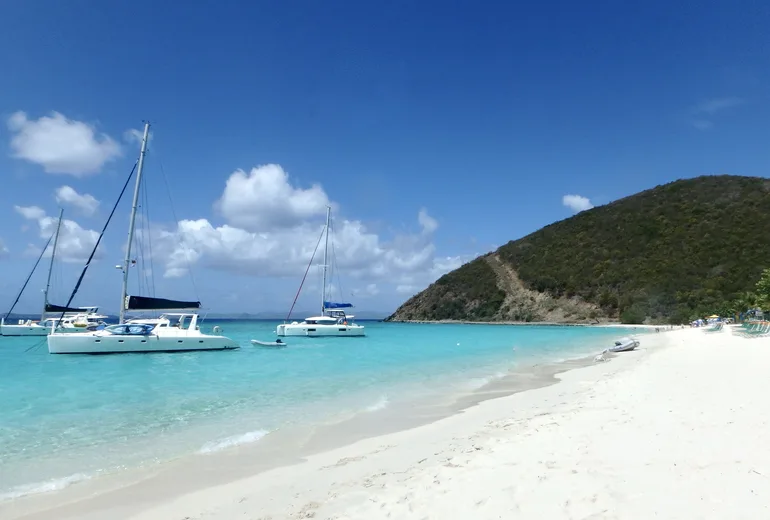
Strip away the badges and the choice gets simple. The best catamaran for Caribbean charter, for you, falls out of two questions: how many are aboard, and how much do you want to sail versus lounge. Here is the practical shortlist most crews land on.
Picking the right length is its own decision, since a 42-footer and a 50-footer charter and handle very differently. We break down the handling, cost and comfort differences in our guide to choosing between a 40, 45 and 50-foot catamaran in the Caribbean.
One unglamorous truth governs the whole exercise: for the December-to-April high season, the most desirable boats are reserved six to twelve months out. A “perfect” Leopard 45 you cannot book in your dates is no use, while a slightly larger Lagoon 46 that is actually available will give you a fine week. Decide on two or three models you would be happy with rather than fixing on one, and start the conversation early. You can compare what is currently free across the islands on our Caribbean charter destinations page, and our team can flag which models are still open for your week.
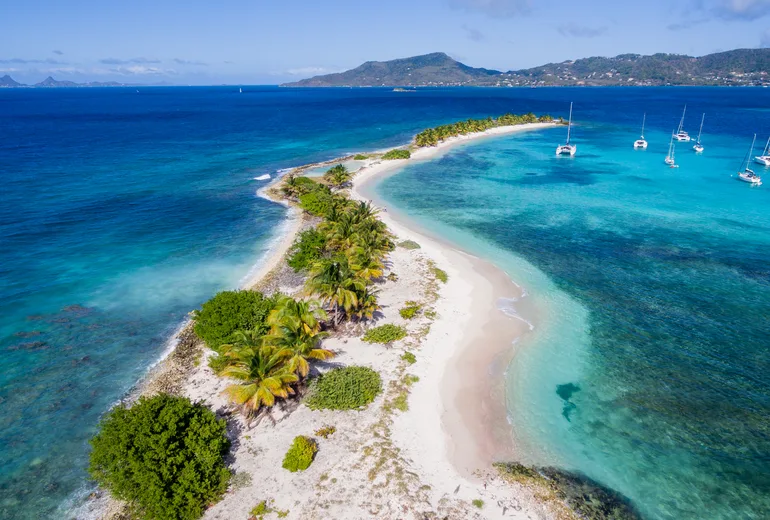
For most first-timers a Lagoon 42 or Fountaine Pajot Astréa 42 is the easiest call. They are forgiving to handle with two competent sailors, comfortable for a family of four, widely available, and sit at the lower end of the price range. You get the catamaran experience without committing to a 50-foot boat on your first trip.
A little, but less than people fear. A 50-foot cat has more windage and needs more room to manoeuvre in a tight mooring field, yet the systems — bow thruster, electric winches, twin engines — make docking manageable. The bigger jump is cost and the size of the deposit, not the difficulty of sailing.
Single-level-helm designs like the Leopard 45 and Lagoon 42 tend to be easiest when a squall hits, because the helm has clear sightlines and a reef goes in quickly. Heavier loft-deck cats cope fine too, but reward a crew that reefs early rather than waiting for the gust.
For the December-to-April peak, aim to book six to twelve months out, especially for popular 45-foot and larger models. Shoulder-season weeks in May or November give you far more choice closer to your dates.
Ready to match a model to your dates and crew? Browse live availability on our Caribbean catamaran charter destinations page and we will help you shortlist the boats that are actually open for your week.
Six short questions, then a real reply within four working hours.