Catamaran CharterCaribbean
— Itinerary
Find your ideal route

Plot the
whole week.

Sample 7- and 14-day Caribbean catamaran routes our brokers would plan themselves. Each is a starting point — we adjust the stops to weather, your group, and the kind of week you want.

— How a charter week works

A Caribbean week has a rhythm.

Three things shape every Caribbean charter — the Saturday turnaround, a sensible daily mile count, and the skipper's freedom to re-plot on the day. Once those are clear, picking a starting region is the easy part.

01 · Saturday rhythm

Caribbean charter weeks run Saturday-to-Saturday. Embarkation at 5 pm Saturday after the cleaning team finishes; disembarkation at 9 am the following Saturday. Some bases (BVI, Le Marin) run shoulder-season Wednesday turnarounds when the fleet has space. Two-week charters chain a Saturday hand-off in the middle — same yacht or upgrade to a larger one for the second week.

02 · Daily distance

Plan for 20–35 NM on sailing days — catamaran cruise speed of 7–9 kt makes a 30-NM leg a comfortable 4-hour day with a swim stop. A 7-day week comfortably covers 90–180 NM, depending on the route. BVI runs short (92 NM total on the classic loop), Bahamas medium (~110 NM Abacos, 150+ NM Exumas), Grenadines long (180+ NM on the 10-day round-trip to Tobago Cays).

03 · Adjustable on the day

Every route here is a starting point. The skipper re-plots day-by-day on the trade-wind forecast, cold-front sequence (Bahamas), cruising-permit timing, the group's stamina, and whether you'd rather chase a quieter anchorage or the beach-bar scene. Pre-departure briefing covers the planned week; on board, the skipper updates each morning on VHF Channel 16.

— Four sailing areas

Every route, by sailing area.

Pick the corner of the Caribbean that fits your week — each card opens onto every route from that base, day-by-day. We adapt the stops to weather, your group, and the kind of week you want.
Tell us about your week →
Bahamas
1 route
— Region 01 · 7 to 14 days
Bahamas
Hope Town · Great Guana · Green Turtle · Staniel Cay · Exuma Cays

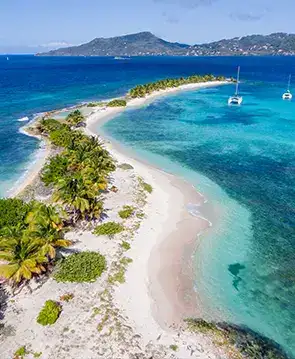
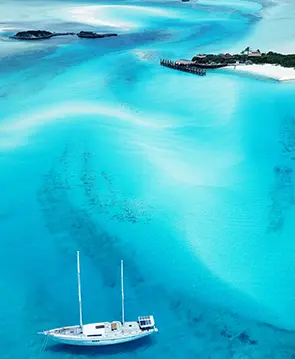
700 islands across 100,000 square miles of turquoise shallow water. Marsh Harbour runs the Sea of Abaco loop (Hope Town's candy-stripe lighthouse, Nipper's beach bar, the long line-of-sight Atlantic-side beaches). Nassau opens the central Exumas — Big Major's pigs, Thunderball Grotto, the Exuma Cays Land and Sea Park. Shallow draft is rewarded with sandbar anchorages monohulls cannot reach.

Explore Bahamas routes→
British Virgin Islands
2 routes
— Region 02 · 7 to 10 days
British Virgin Islands
Norman · Cooper · Virgin Gorda · Anegada · Jost Van Dyke

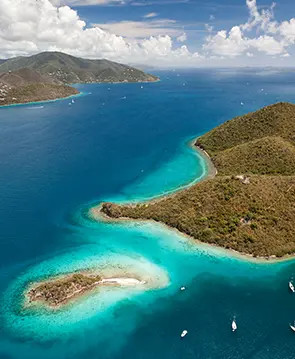
Forty islands inside a thirty-NM radius and line-of-sight sailing inside Sir Francis Drake Channel — the easiest first bareboat in the Caribbean. Charter from Road Town or Nanny Cay on Tortola; reach Norman and The Indians on day one, push out to Anegada by Wednesday, finish the loop at Jost Van Dyke. Catamarans dominate because shallow draft opens sand-bottomed bays that monohulls have to admire from deeper out.

Explore British Virgin Islands routes→
Grenada
1 route
— Region 03 · 7 to 14 days
Grenada
Carriacou · Sandy Island · Union · Tobago Cays · Mayreau

Southernmost charter base in the Eastern Caribbean — below the standard hurricane belt at 12 °N, so the season runs year-round. Port Louis Marina on St. George's lagoon is the hub; the route runs north through Carriacou to the Tobago Cays Marine Park — five uninhabited cays inside a horseshoe reef, the photogenic anchorage of the Eastern Caribbean. Suits second-week charterers and groups chasing turtle snorkel sites.

Explore Grenada routes→
Martinique
2 routes
— Region 04 · 7 to 14 days
Martinique
Sainte-Anne · Anses d'Arlet · Fort-de-France · Saint-Pierre · Diamond Rock

Le Marin runs the largest charter base in the Eastern Caribbean — 400+ catamarans, the freshest Lagoon stock (built 40 km north in La Rochelle), euro pricing and French provisioning. The lee-coast week climbs north from Sainte-Anne past the Anses d'Arlet trio to Saint-Pierre under Mount Pelée. 10-14 day charters add Saint Lucia or push to the Grenadines.

Explore Martinique routes→
— A day at sea

What 20–35 NM actually looks like.

A typical day on a Caribbean catamaran charter — half sailing, half ashore. A morning snorkel stop, a long lunch at anchor, the afternoon trade-wind reach, a beach-bar dinner in port.

07:30
Breakfast on board

Coffee on deck, fresh bread from the marina bakery (or the night-before provisioning), trade-wind check before slipping the lines.

10:00
Anchor up, first leg

Engine out of the anchorage, then sails up on the easterly trades. A swim stop at a snorkel reef around mid-morning — The Indians, Coral Garden, the Underwater Sculpture Park.

13:00
Long lunch at anchor

Hove-to or moored in a quiet bay. Light meal on deck, an afternoon swim. The Caribbean midday sun rewards a shade-stretched lunch.

15:00
Afternoon trade-wind reach

Easterly fills to 18–22 kt by 2 pm reliably. Two to three hours of beam-reach sailing to the evening anchorage — the day-sail of the week.

17:00
Mooring or anchor down

Lines on a National Parks Trust mooring or anchor on white sand. Showers on board, swim before sunset, the skipper books a beach-bar dinner ashore.

19:30
Dinner ashore

Beach-bar dinner — Foxy's at Jost Van Dyke, Nipper's at Great Guana, Salt Whistle Bay at Mayreau, the Frangipani on Bequia. Local rum, fresh fish or lobster. Back on board by 11 pm.

— How to choose

How to choose a Caribbean charter route.

The Caribbean basin gives you four distinct charter regions, each with its own character. The classic catamaran charter Caribbean week is built around one of them — but a two-week charter or a one-way crossing lets you stitch two together. Below is the short version: who each area suits, how the typical Saturday-to-Saturday week looks, and what to weigh up when you pick.

Whatever route you pick, the rhythm is similar: morning swim and snorkel, midday sail on the steady easterly trades, late-afternoon arrival in a sheltered cove or marina, dinner ashore at a beach bar. Distances are short — most days are 20–35 NM, leaving plenty of time at anchor. National-park permits (BVI National Parks Trust, Tobago Cays Marine Park, Bahamas Cruising Permit) are handled by our team when you book.

— FAQ

What clients ask about routes.

Seven nights, Saturday to Saturday across the bareboat catamaran fleet. Embarkation is around 5 pm Saturday after the cleaning/handover team finishes; disembarkation by 9 am the following Saturday. Some bases (BVI, Le Marin) also run mid-week turnarounds in shoulder season. Ten-day and 14-day charters chain a Saturday turnaround in the middle — either same yacht or step-up to a larger one for the second week.
Plan for 20–35 NM on sailing days. Caribbean trade winds are reliable (15–22 kt easterly) but the catamaran cruise speed of 7–9 kt means a 30-NM leg is a comfortable 4-hour day with a swim stop. A 7-day week typically covers 90–180 NM total — the BVI Loop runs 92 NM in 7 days, the Grenadines round-trip pushes 180 NM in 10 days. Push past 50 NM/day in trade-wind sea state and the crew is exhausted by mid-week.
Yes — and we will. Every route here is a starting point. The skipper re-plots day-by-day based on the trade-wind forecast, cold-front sequence (Bahamas), cruising-permit timing, the group's stamina, and whether you'd rather chase a quieter anchorage or a busy beach bar. Pre-departure briefing covers the planned week; on board, the skipper updates each morning on VHF Channel 16.
Seven-day routes loop back to the same base — BVI Loop (Tortola round-trip), Sea of Abaco (Marsh Harbour round-trip), Martinique Lee Coast (Le Marin round-trip), Carriacou run (Port Louis round-trip). Fourteen-day routes are linear (Grenada → Saint Lucia, or Nassau → Marsh Harbour with a Berry Islands stepping-stone) or two-loop (BVI week + St. Martin week sharing a Saturday hand-off). Linear two-week routes typically carry a one-way fee (US$1,500–3,000) but unlock the full Eastern Caribbean arc.
BVI: first-time bareboaters, line-of-sight sailing, biggest fleet, lightest paperwork. Bahamas: shallow-water cruising, lagoons impossible to reach from a monohull, swimming-pig photo. Martinique: cheapest per-week, best French provisioning, largest Eastern Caribbean fleet. Grenada: year-round season below the hurricane belt, launchpad for the Tobago Cays. Each region's card on this page links to every route from that base.
Breakfast on board around 8 am, slip lines by 10 with a swim stop at a snorkel site mid-morning. Lunch at anchor in a lunch bay around 1 pm. Afternoon trade-wind reach (the easterly fills to 18–22 kt by 2 pm reliably) for 2–3 hours to the evening anchorage. Mooring or hook set by 5 pm — well before the trades peak. Dinner ashore at a beach bar (Foxy's, Nipper's, Salt Whistle Bay, the Frangipani) or skipper-cooked on board. Back on board by 11 pm.
— Plan your week

Tailor this route to your week.

Send a brief. A broker will adapt the route to your group, the trade-wind forecast, and the kind of week you want.