

What the Chef Cooks: A Week of Meals on a Crewed Caribbean Catamaran
A real week of meals on a crewed Caribbean catamaran, how preference sheets work, and how chefs source fish, conch and roti en route.
Read more
A Caribbean catamaran charter from the USA is about the shortest trip to real trade-wind sailing any American can take in winter. The nonstop from Miami to Tortola is roughly three hours, the Eastern Caribbean runs one hour ahead of New York from November to March, and there is no jet lag to sleep off, so the first swim off the transom can happen on the afternoon you land.
That makes the planning different from a European trip. The questions are which gateway to fly into, what a base wants to see from a skipper who holds no licence, how the US holiday weeks are priced, and where to go when you have nine or ten days rather than a month. This guide works through each of them for winter 2026/27 and the spring that follows.
For years a British Virgin Islands charter began with a connection in San Juan or St Thomas and then a ferry or a small plane. American Airlines now flies nonstop from Miami to Beef Island, the airport that serves Tortola, on Embraer 175 regional jets, and for winter 2026/27 it is reported to be running up to six flights a day. It remains the only nonstop to Tortola from the mainland, which is why the Saturday seats in February and over the holidays sell early. Book the flight the same week you book the boat.
The aircraft is small, and that shapes the packing. Soft duffels stow better than hard cases, both in the overhead bins and later in a catamaran cabin, and a crew of eight flying in from Denver, Chicago and Boston usually does better meeting in Miami the night before than hoping every connection lines up. From Beef Island it is a short taxi ride to the bases on Tortola’s east end and around Road Town, and Trellis Bay sits right beside the runway if you land with an hour to spare.
The southern islands are reachable too. Miami, New York, Charlotte and Atlanta typically have nonstops to Antigua, St Lucia, Barbados and Grenada in winter, so a crew that has already done the Virgins can aim further south without adding much travel time. West Coast crews should plan on a red-eye or a full day of connections whichever island they choose.
St Thomas in the US Virgin Islands is the other way in, and it is often the cheaper one. Flights from the East Coast hubs are frequent, fares can undercut the Tortola nonstop, and because the USVI is US territory an American needs no passport to land there. Plenty of crews take advantage of that, spend a night in Charlotte Amalie or Red Hook, and cross to Tortola the next morning.
The ferry is where the passport comes back. The BVI is a separate British territory, so every member of the crew, children included, needs a valid US passport book to enter at West End or Road Town. Check the ferry timetable for your arrival day before you buy the flight, because a late landing can miss the last crossing, and allow time on the way home for the US customs checks at the St Thomas airport.
A related question comes up on most American bookings: can the boat sail over to St John for lunch in Cruz Bay? Sometimes, but ask the base before you plan it. Many BVI charter contracts limit or condition trips into US waters, and the whole crew has to clear out of the BVI and into the USVI, then do the reverse, which can eat most of a day.
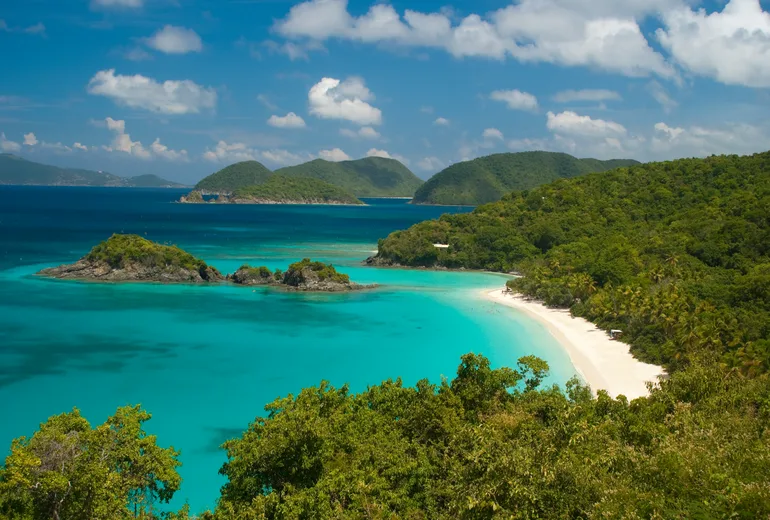
Neither the BVI, nor St Vincent and the Grenadines, nor Antigua requires a sailing licence for a bareboat charter by law. Sailors who have looked at Croatia or Greece, where an ASA 104 card or an ICC is checked by the authorities, are often surprised. In the Caribbean the decision sits with the charter company, and the company looks at your sailing résumé.
A résumé that gets approved quickly lists the boats you have skippered with length and type, the waters you sailed them in, the number of days or seasons, and whether you have anchored overnight, picked up moorings and run a dinghy. ASA and US Sailing certificates help because they show what you were assessed on, and the ASA catamaran course is worth mentioning if you have it. Logged days on the Chesapeake, Long Island Sound or Puget Sound count for at least as much. A state boater-education card on its own says little about handling a 45 ft catamaran, so do not lead with it.
Expect a chart briefing at handover and, at many bases, a short check-out under way. If the base is not convinced, it typically asks for a skipper for the first day, less often for the whole week; a skipper usually runs about €220 to €280 a day plus food. Our page on what BVI bases want instead of a sailing licence covers the résumé in detail. Send it when you book, not the week before, so there is time to fix a gap.
Prices on this site are contract prices in euros and are shown converted into US dollars, at roughly US$1.15 to US$1.20 to the euro as of November 2026. Rates move; the euro figure you sign does not. In the islands many operators quote in US dollars or euros, so compare like with like. For a 42 to 45 ft bareboat catamaran in the BVI, a winter week typically costs US$6,000 to US$12,000, about €5,000 to €10,400, and the Grenadines sit in a similar band. Split between eight people that is roughly US$750 to US$1,500 each for the boat, before flights, food, fuel and mooring fees. Crewed catamaran hire, with captain and chef aboard, starts at around US$20,000 a week in the BVI, roughly €17,000.
Where your week falls in the American calendar moves the price more than the boat model does:
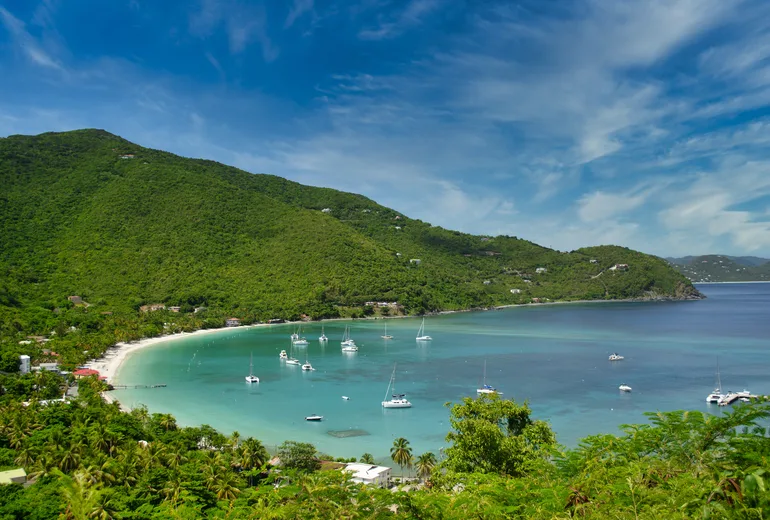
The typical American trip is a Friday flight out, seven or eight nights aboard and a Sunday flight home. That shape favours the cruising ground with the least travel at each end.
The BVI wins on logistics. With the Miami nonstop you can be aboard by Saturday afternoon, and the Sir Francis Drake Channel keeps legs short and sheltered: Norman Island and the Bight on the first night, Cooper Island, The Baths and North Sound on Virgin Gorda, then Jost Van Dyke on the way back. Add a night or two and Anegada, low and reef-ringed, fits in on a settled day.
The Grenadines ask more. You fly into Grenada or St Vincent, the open-water passages run up to 30 nautical miles with a full Atlantic swell, and you clear customs between Grenada and St Vincent and the Grenadines at Carriacou and Union Island. In exchange you get Bequia, the Tobago Cays and Salt Whistle Bay on Mayreau with a fraction of the BVI traffic. The fleet is smaller, so it books out sooner; our piece on why the Grenadines sell out earlier than the BVI explains the gap.
The Leewards, from Antigua or St Martin, sit in between: nonstops from several US hubs, day sails of 15 to 20 nautical miles, and French, Dutch and British islands within one week. For a first trip with a mixed-experience crew, most Americans we work with still start in the BVI and save the Grenadines for year two.
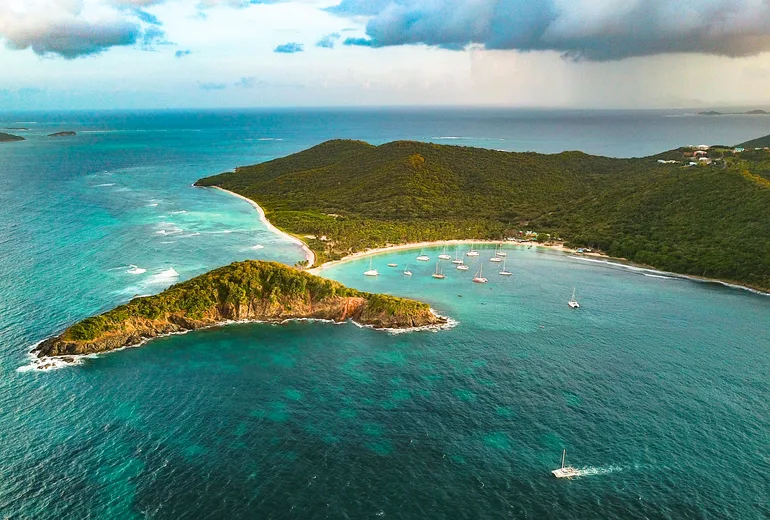
From December to April the trades blow from the east or northeast at 15 to 25 knots, a little stronger than many sailors from Annapolis or Newport expect for a holiday. A catamaran does not heel to warn you, so reef by the wind speed on the instrument, not by feel, and put the first reef in before you leave a mooring on a breezy morning. Squalls show up as dark lines to windward, bring a burst of rain and a 30-knot gust, and pass in ten minutes. In the Virgins the channels stay fairly flat; between islands further south the swell is long and full.
Provisioning in Tortola feels familiar: US brands, US dollars, island prices. Most crews pre-order the heavy items such as water, beer, soft drinks and breakfast staples for delivery to the boat, then shop for fresh fish and fruit along the way. Fresh water is the limit on many charter catamarans, so short showers and a check of the tank gauge each evening matter more than the size of the fridge. Our Tortola provisioning guide has the list and a realistic budget per person.
Plan the route around the wind as well as the bars. Going east into the trades is the hard work, so do it early in the week and on calm mornings, then run back downwind once the crew has found its rhythm. Painkillers at the Soggy Dollar on Jost Van Dyke taste better after an easy reach than after a two-hour beat.
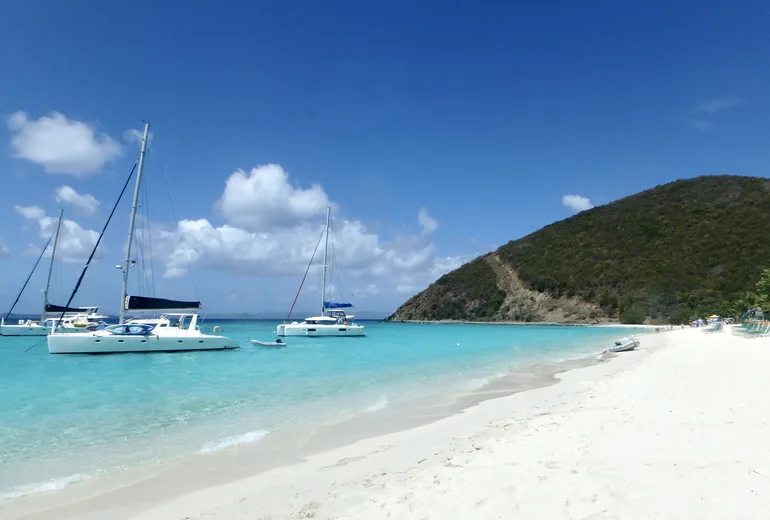
The Atlantic hurricane season runs from 1 June to 30 November, with the peak from August to October. Charter prices drop in those months, and they line up with the US school summer, so the temptation is real. The trouble is the flexibility a storm demands: a named system can close a base, cancel island flights and leave you rebooking with fixed vacation days. For a summer sailing trip, the Mediterranean is the better bet that year.
Late November and early June are the edges, and some crews do sail them with good results, especially in the southern Grenadines. If you book a week inside the season, read the contract’s storm clause and check what your travel insurance covers before you pay. Our explainer on what happens when a hurricane hits your charter week walks through the usual rebooking terms.
From December to the middle of May, hurricanes are not a realistic concern, and that window is long enough to fit most American holiday calendars. The real competition in those months is for boats, not for weather.
Yes. You can land in St Thomas without one because the USVI is US territory, but the ferry to Tortola takes you into the British Virgin Islands, and every traveller needs a valid US passport book to enter. Children need their own passports too.
About three hours on American Airlines’ nonstop to Beef Island, the only nonstop to Tortola from the US mainland. For winter 2026/27 it is reported to run up to six times a day, which still sells out on holiday weekends.
No licence is required by BVI law. The charter company reviews your sailing résumé and may run a check-out; if your experience is thin, it typically asks you to take a skipper for a day or for the week.
Expect the top of the market. A 42 to 45 ft bareboat catamaran runs about US$6,000 to US$12,000 a week in normal winter weeks, and Christmas and New Year sit above that, often with minimum stays. Book nine to twelve months ahead.
Late April and May, after Easter and before the hurricane season, offer lower prices with dry-season weather. Thanksgiving week is the other good-value window if you can book late.
When your dates are firm, compare the Caribbean bases and island groups for your winter week and tell us your crew size and travel dates; we will tell you which catamarans are still open and quote the contract price in euros with the dollar estimate alongside.
Six short questions, then a real reply within four working hours.
Your privacy
You can read more about how we protect your personal data and use cookies in our Privacy Policy.
With your consent, we and Google use cookies and similar technologies to store and access information on your device and to process personal data such as your visit to this website, your IP address and cookie identifiers. You can withdraw your consent at any time through “Cookies” at the bottom of every page.
We and Google process data for:
Website analytics and visit statistics, recordings of visits to improve the website, ad measurement and remarketing, storing and accessing information on your device