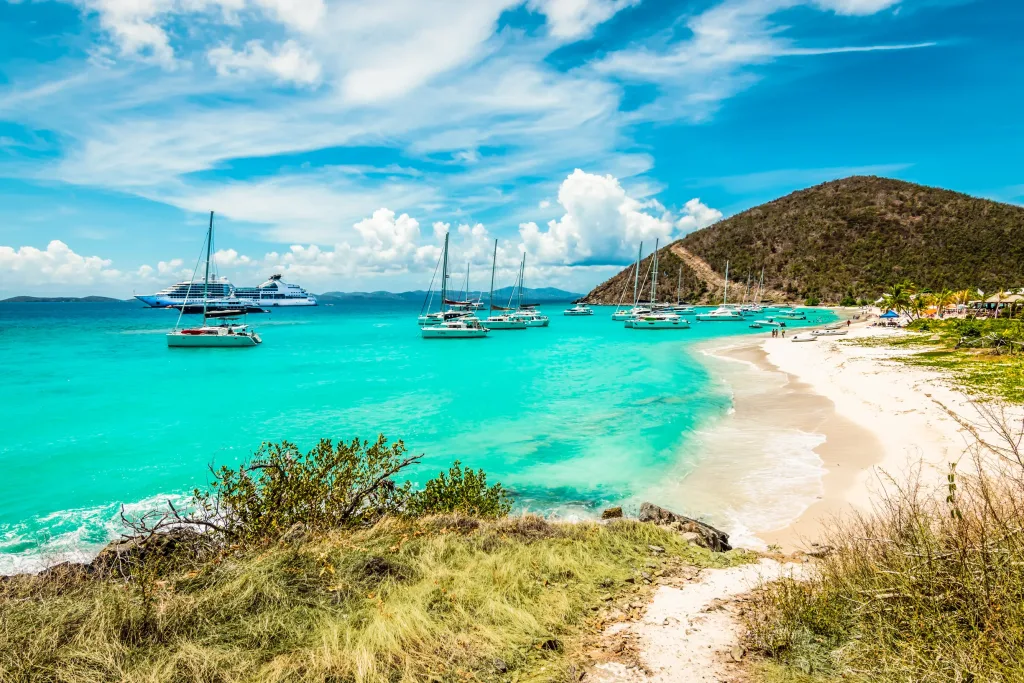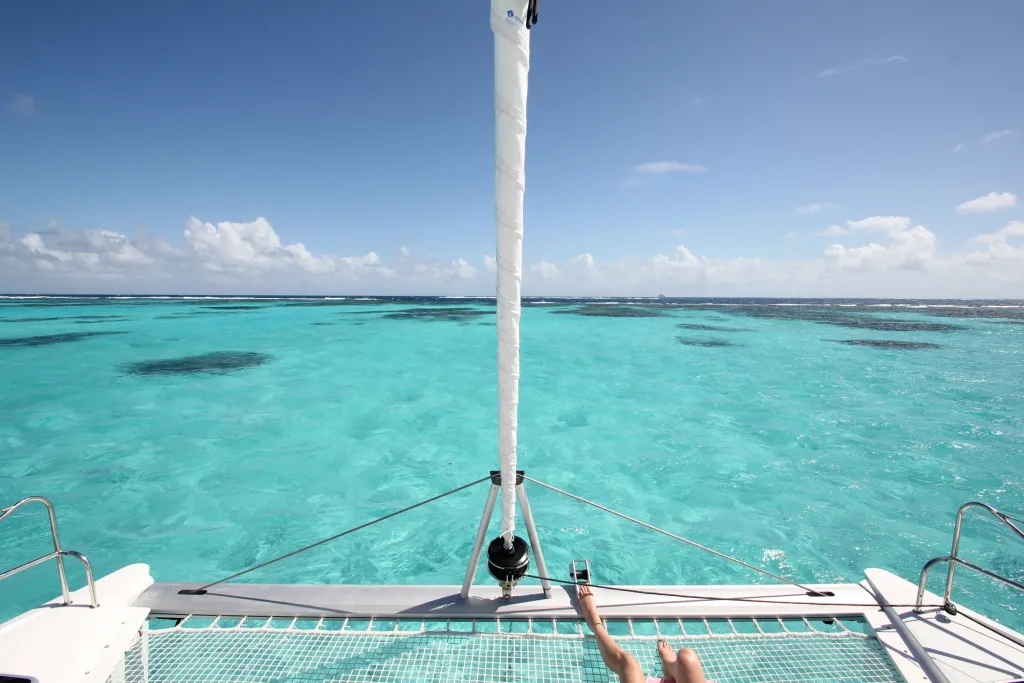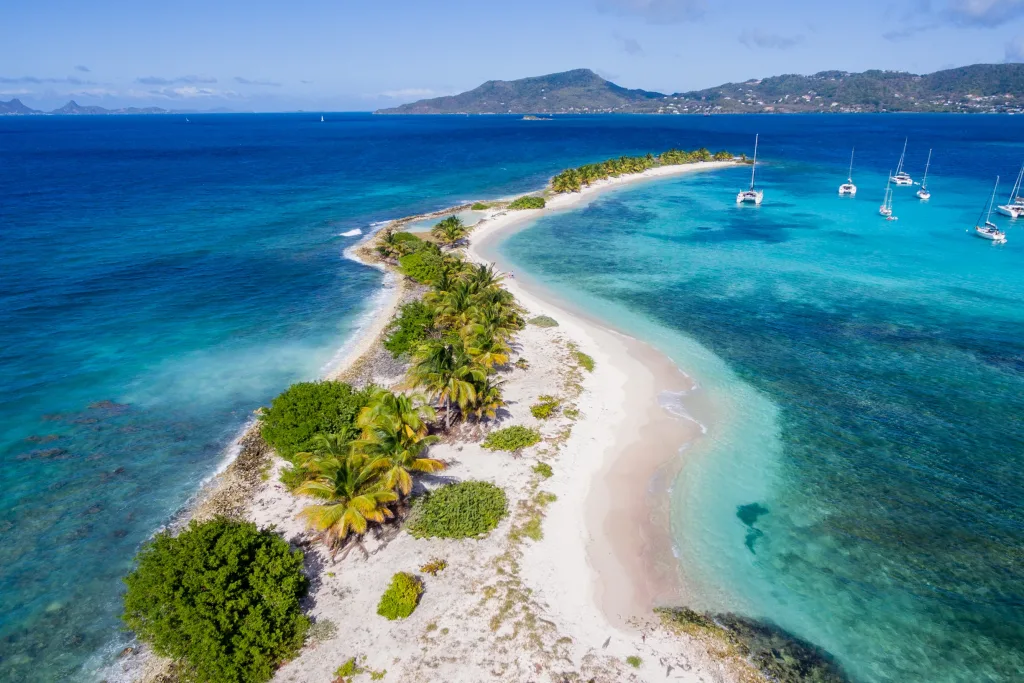
Thanksgiving Catamaran Charter 2026: The Caribbean’s Best Last-Minute Window
Why late November is the quiet pre-peak window for a Caribbean catamaran, with fresh boats and pre-holiday rates while there’s still availability.
Read more
The single decision that shapes the cost and comfort of a Caribbean charter week isn’t the destination or even the dates. It’s length. Get the boat size right and eight friends sleep well, share the cooking, and split a bill that feels fair. Get it wrong and you’re either paying for empty cabins or stepping over each other for seven nights.
So what size catamaran for charter actually makes sense for your group? The honest answer is that it comes down to head count, how well everyone knows each other, and how much you’re willing to spend per person. Below is the real cabin-and-berth math for the three sizes that dominate Caribbean fleets, plus where each one starts to pinch.
Charter cats are sold by their nominal length, but what you’re buying is a cabin layout. Production builders like Lagoon, Bali, Leopard and Fountaine Pajot configure most charter boats in one of two ways: an “owner” version with three cabins and a private master hull, or a four-cabin “charter” version with a head in each. For a group splitting costs, you almost always want the four-cabin layout, because the price per couple drops sharply once you fill those berths.
Here’s the rough shape of it. A 40 to 42-foot cat typically gives you four double cabins sleeping eight, sometimes with two heads shared between them. Step up to 45 to 47 feet and you usually get four cabins with four ensuite heads, more saloon space, and a galley you can actually cook a real meal in. At 50 feet and above you’re into four large ensuite cabins plus crew or skipper quarters in the bows, with room for ten guests on some layouts.
The trap is assuming bigger is simply better. It often is, but every extra five feet adds cost, draft and handling weight, and on a busy week it can also limit where you tie up. Match the boat to the bodies, not to the brochure photo.
A 40 to 42-foot cat is the workhorse of the Caribbean bareboat fleet, and for good reason. It’s nimble, sips less fuel, fits almost any mooring field, and a competent crew can handle it short-handed. For four to six people who know each other well, it’s plenty. Push it to eight and the boat works, but the shared heads and tighter saloon start to tell by midweek.
Where this size shines is the British Virgin Islands and the Bahamas banks, where shallow draft matters. A Lagoon 40 or Bali 4.2 draws roughly 1.2 to 1.4 metres, which lets you tuck into thin water around the Exuma cays or nose toward Anegada’s reef-protected anchorages without sweating the depth sounder. If your group is six adults or a young family, this is usually the sweet spot for value.
Budget-wise, a bareboat 40-footer in the BVI runs roughly $7,000 to $11,000 a week in shoulder season, climbing hard over Christmas and the February-March peak. Crewed versions in this size are rarer, since most crewed clients want more space. For a deeper line-by-line look at where the money goes, our complete Caribbean catamaran charter cost breakdown walks through base rate, fees and extras.
If we had to point one boat size at a typical group of eight adults, it would be the 45 to 47-foot range. This is where you get four genuine ensuite cabins, so every couple has its own head and a door that closes properly. The saloon seats everyone for dinner, the galley has fridge and freezer space for a week’s provisioning, and the foredeck trampoline is big enough that two people can sunbathe without negotiating.
Boats like the Lagoon 46, Bali 4.6, Leopard 45 and Fountaine Pajot Saona 47 sit right in this band. They sail noticeably better in the trade winds than the smaller cats, holding a steadier 6 to 8 knots on a reach between islands, and the extra waterline makes the ride across an open passage like Tortola to Anegada (about 15 nautical miles, two to three hours) far more comfortable. Most days you’ll motor-sail anyway, but on the lively beam reaches the Caribbean is famous for, the bigger boat earns its keep.
Expect to pay a meaningful step up over the 40-footer. A bareboat 46 in the BVI often lands around $11,000 to $16,000 a week outside the holidays, and the all-inclusive crewed versions start climbing into serious money. If you’re weighing the crewed route at this size, our guide to all-inclusive crewed catamaran price tiers by boat size lays out exactly what each tier includes.
It sounds like a small thing until you’re aboard. On a four-cabin, two-head boat, eight people queue for a shower after a day of swimming and one blocked head becomes everyone’s problem. With four ensuites, each couple owns their space, and the social temperature of the boat stays warmer all week. For mixed groups of friends rather than one family, this is often the deciding factor.
Cross 50 feet and the boat changes character. A Lagoon 50, Bali 5.0 or Lagoon 51 gives you large ensuite cabins, a flybridge helm, and the deck real estate for ten guests to spread out without anyone feeling boxed in. These boats almost always come with a generator and air conditioning that can run overnight, plus a watermaker on many, which matters enormously in the tropics. For a detailed walkthrough of one of the most-chartered boats in this class, see our Lagoon 51 review for Caribbean charter.
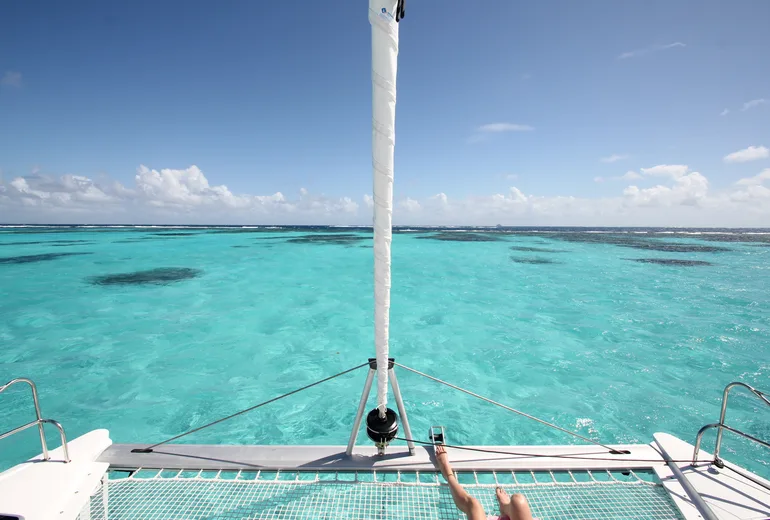
The catch is twofold. First, cost: a crewed 50-plus footer in peak season can run $30,000 to $45,000 and beyond, before bar and tips. Second, handling and access. A 50-foot cat draws a bit more, weighs a lot more to bring alongside in wind, and its wider beam means some tighter marina berths and a few mooring fields simply won’t take it. In the BVI’s busier anchorages you’ll occasionally find the prime balls already gone to boats that arrived early, so plan to drop the hook by mid-afternoon.
For ten people, or for anyone who wants the comfort of a full-time skipper and chef, the big cat is the right answer. For eight, it’s often more boat, and more money, than the trip needs.
Strip away the brochures and the choice usually falls out like this. Four to six people who get along: a 40 to 42-foot cat keeps costs down and gets you into the shallow anchorages. Eight adults, especially couples who want privacy: a 45 to 47-footer is the comfortable, sensible middle. Nine or ten guests, or anyone wanting overnight AC and a crew: step up to 50 feet and accept the price.
Two practical caveats. Don’t book to your maximum berth count and assume everyone will tolerate a pullman bunk in the bow or a saloon-convertible bed all week; those berths are fine for kids or the occasional guest, less so for paying adults over seven nights. And remember that a slightly bigger boat shared among more people often costs less per head than a small boat split between four, which is why filling cabins beats chasing the lowest sticker price.

Size matters more when supply is tight, and Caribbean winter inventory tightens fast. The four-ensuite 45 to 47-foot boats are the first to go because they suit the most common group, eight adults, so by autumn the choice of these for the December-to-March window narrows quickly. If your dates are fixed and your group is set, lock the size you want early rather than settling for whatever’s left. When you’re ready to compare boats and dates, browse the full range on our Caribbean catamaran charter destinations page.
For eight adults, a 45 to 47-foot four-cabin catamaran with four ensuite heads is usually the best fit. Each couple gets a private cabin and bathroom, the saloon and galley handle the group comfortably, and the boat sails well in the trade winds. A 40 to 42-footer can technically sleep eight but the shared heads and tighter living space tend to feel cramped by midweek.
Expect a substantial jump. A bareboat 45 to 46-footer in the BVI often runs $11,000 to $16,000 a week outside the holidays, while a 50-foot boat and the larger crewed cats climb well past that, with peak-season crewed 50-plus footers reaching $30,000 to $45,000 before bar and tips. The extra length buys bigger cabins, a generator, overnight AC and often a watermaker.
Not necessarily. A larger cat gives more space and better systems, but it draws more, is harder to bring alongside in wind, and its wider beam can rule out some moorings and tighter berths. The most comfortable choice is the boat that matches your group size, so eight people are often happier on a well-laid-out 46 than rattling around, and overpaying, on a 52.
Yes. Shallow-draft cats in the 40 to 46-foot range, drawing roughly 1.2 to 1.5 metres, get into thin water around the Bahamas banks and reef-fringed BVI anchorages more easily. Bigger boats need more depth and swing room, and in busy mooring fields the prime balls can be taken by early arrivals, so larger cats benefit from reaching an anchorage by mid-afternoon.
For the Christmas-to-March peak, yes. Four-ensuite 45 to 47-foot cats sell out first because they suit the most common group of eight adults. If your dates and group are fixed, reserve the size you want well ahead rather than risk being left with only smaller or larger boats than your trip really needs.
Not sure which boat fits your crew and budget? Start by comparing boats and dates across our Caribbean catamaran charter destinations and match the size to your group before the winter fleet thins out.
Six short questions, then a real reply within four working hours.